
Why Custom Jewelry Brands Audit a Manufacturer Before Ordering
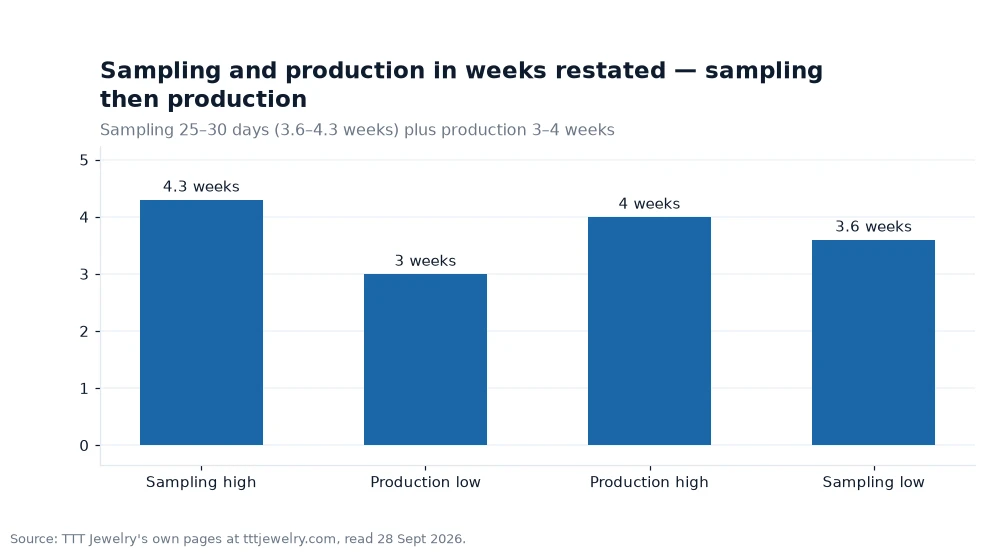
An audit before a first order is not a suspicion of the factory; it is a transfer of risk from the brand's launch calendar to a paper trail. The questions are narrow: what quality system applies, which substances the plating excludes, who owns the tooling, and what happens when a sample fails. A single failed sample restarts 25–30 days of a 48–60 day pre-production route, which is roughly half the schedule lost to one unverified assumption.
Key takeaways
- Four documents carry most of the audit: quality system scope, social audit report, substance declaration and exclusivity clause.
- ISO 9001:2015 covers process control across stages; it does not certify a product or a finish.
- Exclusivity is enforceable only when moulds, CAD files and the collection are named in the agreement.
- A failed sample costs 25–30 days, about 50–63% of a 48–60 day route, so sampling is the audit's real test.
An audit is a document exchange first
Site visits are useful, and they are also the part of an audit that is easiest to stage. The part that resists staging is paperwork, because documents have dates, scopes and issuing bodies. A brand can run a credible first-pass audit from a desk by asking for four items and reading them closely, then deciding whether a visit would add anything.
This is not an argument against visiting. It is an argument for sequencing: read first, visit second, sample third. A visit conducted before the documents are read tends to produce impressions rather than findings, and impressions are hard to compare across three shortlisted factories.
The desk stage also sets the commercial frame. Once a brand knows the quality system, the minimum quantities and the sampling window, it can estimate the cash and the calendar required before a single piece exists. That estimate is what the audit is protecting.
What each certificate actually covers
ISO 9001:2015 certifies a quality management system. In a jewellery context that means documented control of production stages: how a specification is issued, how a change is recorded, how an inspection is signed off. It says nothing about whether a particular pendant is nickel-free. Buyers who treat the certificate as a product claim are reading it one level too high.
BSCI covers labour and social compliance. It answers questions about working conditions rather than about metal. For a brand whose retail partners ask for supply-chain assurances, this is the document that speaks to those questions, and its scope statement matters as much as its result.
REACH covers restricted substances and is the relevant framework for lead, cadmium and nickel. The published position is that pieces are free of those three, and that plating is 100% compliant with REACH and with CA Prop 65. Those are two separate statements about two separate layers: the substrate and the coating. A declaration that covers only the alloy leaves the plating unaddressed, and plating is the layer that touches skin.
The exclusivity file
Design ownership is where audits most often stop being technical and start being commercial. The published terms are a 100% NDA, designs 100% exclusive to the brand, and moulds, CAD files and the collection not resold or shown. Read as an audit item, that breaks into three questions: who holds the mould, who holds the file, and what prevents either from appearing in another client's range.
Ask for the clause, not the promise. A factory that works with several brands in the same category has an obvious incentive to reuse a popular silhouette, and the only thing that stops reuse is a contractual term with a defined consequence. Brands that skip this step sometimes discover the issue only when a competitor's lookbook contains a familiar curve.
The file question has a practical edge too. If the CAD belongs to the brand, moving production later is straightforward. If it belongs to the factory, the brand's leverage ends with the relationship.
This is the point at which the choice of a private label jewelry manufacturer becomes a legal decision as much as a production one. A supplier that will not name the file owner in writing is offering capacity, not a partnership.
| Document | What it proves | What it does not prove |
|---|---|---|
| ISO 9001:2015 scope | Documented control across production stages | That a specific SKU meets a substance limit |
| BSCI audit reference | Labour and social compliance reviewed | Anything about alloy or plating chemistry |
| REACH declaration | Lead, cadmium and nickel excluded | That packaging inks are compliant |
| CA Prop 65 plating note | Coating layer assessed for the US market | Performance after prolonged wear |
| NDA and non-resale clause | Tooling, CAD and collection exclusivity | That a similar design was never made before |
The sample is the last piece of evidence
Documents describe a system; a sample demonstrates it. That is why the sampling stage deserves more scrutiny than the certificate folder. A master sample at 25–30 days is the first object that combines the alloy, the casting, the polish, the plating and the stone setting into one artefact a buyer can hold.
Approve it against a written specification rather than a feeling. Check the dimensions against the drawing, the plating colour under an agreed light, the weight against the stated band, and the hallmark placement. Record the version. A sample approved by photograph and a sentence is a sample that will be re-argued at bulk.
Worked example
Take a brand that audits and a brand that does not, both ordering 50 pieces in 925 sterling silver. The audited brand confirms the declaration, the minimum and the window before paying; the route runs 2 days of CAD, 25–30 days of sampling and 21–28 days of bulk, for 48–60 days.
The unaudited brand discovers at sample stage that the plating route it assumed does not match the substrate. The sample is rejected. Sampling restarts at 25–30 days. Set that against the original route: 25 ÷ 48 = 52% at the fast end and 30 ÷ 60 = 50% at the slow end. One avoidable rejection adds roughly half the pre-production calendar, and it adds it after the launch date has already been announced.
Add the cash consequence. Fifty silver pieces is the published minimum for that metal; the same design in artisan eco-brass would require 100 and in stainless steel 100+. A brand that switches substrate late to save time does not save quantity — it doubles it, and doubles the packaging count with it.
Frequently asked questions
Does an ISO 9001:2015 certificate mean the jewellery is nickel-free?
No. It certifies quality management across production stages. Nickel, lead and cadmium claims rest on the REACH declaration, with plating separately covered by REACH and CA Prop 65 compliance.
What should an NDA cover in jewellery manufacturing?
It should name the moulds, the CAD files and the collection, and state that none are resold or shown to other clients. Designs are published as 100% exclusive to the brand.
Can an audit be completed without visiting the factory?
A first pass can. Scope statements, audit references, declarations and contract clauses can all be read remotely. A visit adds most value after the documents and the sample have been reviewed.
What the audit is protecting
The output of a good audit is not a verdict on a factory. It is a short list of assumptions that no longer need to be made, each replaced by a document, a number or a clause.
That matters most when a collection spans materials. A brand testing a shape in custom jewelry wholesale volumes can prove the design in one substrate before committing the range to another, and each substrate brings its own declaration to file.
Stainless is the clearest example. A stainless steel jewelry manufacturer working in 316L is dealing with a different plating chemistry from a silver line, and PVD vacuum plating carries its own process controls. TTT Jewelry sets out both the compliance position and the OEM/ODM route on its own pages, which is the starting point for a desk audit rather than the end of one.
Source note: figures come from the manufacturer's own website (tttjewelry.com), read 28 Sept 2026.[1]