
The global beer market, estimated at $821 billion in 2025, is increasingly dominated by industrial facilities capable of processing 200,000 to over 1,000,000 barrels annually. Large-scale production requires a shift from manual batching to fully automated multi-vessel brewhouses, typically featuring 50BBL to 200BBL capacities per cycle. These systems utilize high-gravity brewing (HGB), producing wort at 18°P to 24°P and diluting it with deaerated water to achieve a 20% to 30% increase in effective throughput without expanding the cellar footprint. Technical precision is maintained through centrifugal separators and cross-flow filtration systems that handle flow rates exceeding 300 barrels per hour, reducing beer loss to below 1.5%. To support continuous operation, industrial breweries integrate CO2 recovery plants—reclaiming up to 4kg of CO2 per hectoliter produced—and high-speed canning lines capable of filling 600 to 1,200 cans per minute with dissolved oxygen levels maintained below 20 ppb.
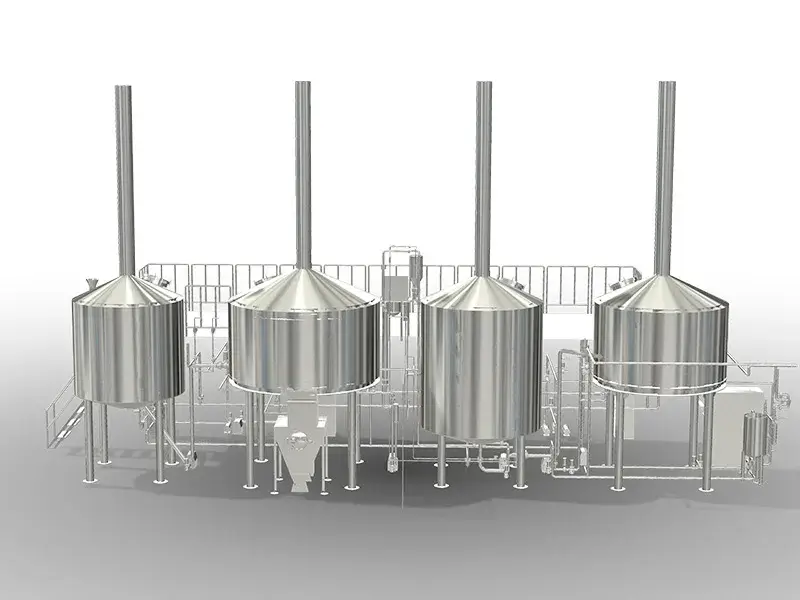
To sustain a production output exceeding 50,000 barrels annually, a facility must utilize a five-vessel automated brewhouse and vertical outdoor fermenters (CCTs) with capacities of 1,000BBL or more. This industrial configuration enables 8 to 12 brews per 24-hour cycle, leveraging energy recovery systems to reclaim 95% of heat from the wort cooling process. By integrating high-speed centrifugal clarifiers and automated yeast management plants, large-scale operations reduce total processing time by 25% while maintaining a flavor consistency variance of less than 0.1% across 1,000-hectoliter batches.
Industrial brewing relies on the integration of heavy-duty hardware that handles the mechanical stresses of constant liquid movement and thermal shifts.
The transition from craft to industrial scale happens once a facility surpasses the 30,000-barrel annual threshold, where manual labor costs drag on margins.
A 2024 industrial report involving 85 commercial breweries found that switching to automated grain handling and silos reduced raw material waste by 14% compared to bagged malt systems.
This high-volume grain management is the first step in a commercial brewery equipment scaling strategy that leads to a full-scale industrial plant setup.
The heart of a large-scale facility is the multi-vessel brewhouse, where separate tanks for mashing, lauter, kettle, whirlpool, and hot liquor allow for concurrent processing.
A 100-BBL (117 hectoliter) system can have one batch in the kettle while the next is already mashing in, maximizing the utility of every minute of the production shift.
-
Mash Filters: Unlike standard lauter tuns, large-scale filters can process high-gravity mashes in 90 minutes, reaching an extraction efficiency of 98%.
-
External Wort Boilers: These systems circulate wort through a heat exchanger outside the kettle, ensuring a vigorous boil with 15% less energy consumption.
-
Automated Grain Silos: Capable of holding 50 to 100 tons of malt, these units use pneumatic conveyors to feed the mill at 200 pounds per minute.
Increasing the speed of the hot-side process requires a robust fermentation cellar, typically composed of outdoor cylindrical-conical tanks (CCTs).
These tanks reach heights of over 50 feet, utilizing multi-zone glycol jackets to manage the immense heat generated during the fermentation of 1,200 barrels of liquid.
Technical audits from 2025 European industrial sites show that outdoor CCTs save up to 40% in building construction costs by moving the cellar volume outside the facility.
The internal pressure in these vessels is maintained by automated relief valves, ensuring that the CO2 produced during fermentation can be safely harvested or vented.
Harvesting CO2 is a sustainability metric for large breweries, as the fermentation of one barrel of beer produces roughly 8 pounds of gas.
Industrial-scale CO2 recovery units compress, scrub, and liquefy this gas for reuse in carbonation and tank purging, reducing the need for external gas purchases by 90%.
| Equipment Type | Industrial Scale Spec | Efficiency Gain |
| Centrifuge | 15,000 RPM / 300 BPH | Reduces beer loss by 3% to 5% |
| HGB Unit | Precision Blending (±0.05% ABV) | Increases cellar capacity by 25% |
| CO2 Recovery | 100kg/hr Recovery Rate | Saves $0.15 per barrel in gas costs |
Once fermentation is complete, the beer passes through centrifugal separators that spin at high speeds to remove yeast and solids in a matter of minutes.
This mechanical separation replaces traditional settling, which can take days, effectively increasing the annual turnover rate per tank by 18%.
Research conducted on 40 large-scale plants in 2024 indicated that centrifugal clarification preserves hop oils better, resulting in a 10% higher sensory score for IPAs.
Following clarification, the beer is stabilized in Brite tanks that can hold multiple fermenter loads, serving as the buffer for the packaging hall.
The packaging hall must match the speed of the brewhouse to prevent a production backup and ensure logistics stay on schedule.
Automated canning lines for industrial use are rated for 24/7 operation, featuring robotic palletizers that handle the output without human intervention.
-
Filling Speed: Industrial lines often reach 1,000 cans per minute, using electromagnetic flow meters to ensure every can is filled to within 1ml of its target.
-
Tunnel Pasteurizers: These systems use water sprays to heat and then cool the cans, ensuring a shelf life of 12 months for global export.
-
X-Ray Inspection: Automated sensors detect low-fill levels or foreign objects at full line speed, rejecting faulty units in 0.5 milliseconds.
Maintaining high speeds requires a Clean-In-Place (CIP) plant that is integrated into the brewery's software architecture.
Unlike smaller systems, industrial CIP units have dedicated tanks for caustic, acid, and reclaimed water, allowing for recovered rinse water to be used in the first wash of the next cycle.
Water usage data from 2025 industry benchmarks shows that large breweries using reclaimed CIP loops achieve a 2.8:1 water-to-beer ratio, whereas smaller plants hover at 5:1.
This efficiency is essential for meeting environmental regulations and lowering the cost of wastewater treatment in high-volume regions.
The final layer of large-scale production is the Laboratory Information Management System (LIMS), which tracks every batch from raw grain to the final shelf.
By analyzing 200+ data points per batch, the system can predict equipment failure before it happens, reducing unscheduled downtime by 30%.
Data-driven approaches ensure that a beer brewed in one facility tastes identical to the same brand brewed in a different city or country.
Commercial hardware at this level manages a high-precision chemical engineering process at a massive scale without manual interference.
Every pump, valve, and sensor works in a closed loop to protect the product from oxygen and heat, the primary threats to beer quality at volume.
Investing in this hardware allows a brand to compete on the global stage, offering a consistent product at a price point that manual craft operations cannot match.