
Scent training does not make a product team into perfumers, and it should not be bought as though it would. What it reliably changes is the quality of the conversation: teams describe what they smell with shared vocabulary, they brief a direction rather than a comparison, and they evaluate samples consistently enough that one person's preference stops deciding the outcome. The trade-off is real, because the same budget could buy more samples or a longer development window.
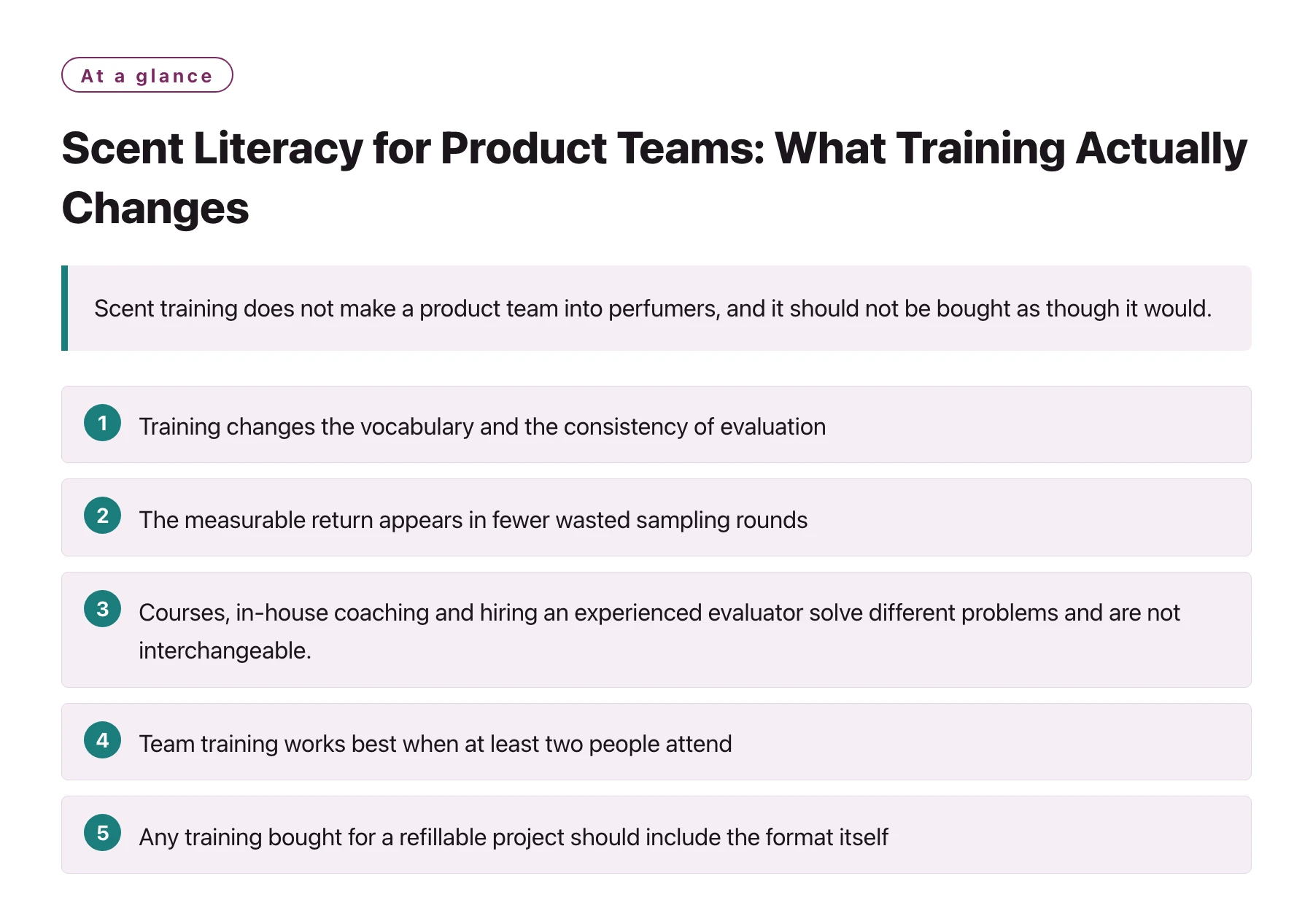
Key takeawaysTraining changes the vocabulary and the consistency of evaluation, not the brand's access to creative talent. · The measurable return appears in fewer wasted sampling rounds, because briefs become specific enough for a perfumer to act on. · Courses, in-house coaching and hiring an experienced evaluator solve different problems and are not interchangeable. · Team training works best when at least two people attend, so that evaluation can be cross-checked rather than held by one nose. · Any training bought for a refillable project should include the format itself, because wear and dispensing behaviour change what a panel notices.
Product teams are usually assembled from people who are good at positioning, packaging and channel, and who have never been taught how to smell analytically. That is not a weakness until the first sample round, when five people give five different verdicts and the decision defaults to whoever speaks with most confidence.
The question is not whether scent literacy is useful. It is what to buy, for whom, and what a brand should expect to change. This article sets out the trade-offs honestly, including the cases where the money is better spent elsewhere.
Three routes, three different returns
| Route | What it builds | Where it falls short |
|---|---|---|
| Structured courses | Shared vocabulary, knowledge of materials and families, and a method for describing a scent | Takes time away from the launch, and knowledge fades without regular practice |
| In-house coaching with the supplier | Evaluation discipline applied to your own briefs and formats, on your own samples | Depends on the supplier's willingness to explain reasoning rather than recommend a direction |
| Hiring an experienced evaluator | Immediate judgement and a single accountable owner for approvals | Concentrates knowledge in one person and adds a permanent cost |
| Museum and exhibition visits | Context and curiosity, and a memorable way to align a team on references | Entertaining without being systematic unless it is paired with a brief |
| Doing nothing until a problem appears | No upfront cost | Sampling rounds repeat, and the brief gets rewritten after every panel instead of before it |
Choose the route by the problem you actually have. Inconsistent evaluation is a training problem; missing creativity is not.
What changes when a team can describe what it smells
Briefs become directions instead of comparisons
A brief written as a request to smell like a well-known commercial scent gives a perfumer very little to work with and creates a legal risk in the market. A brief written in terms of materials, weight and structure gives the perfumer room to build something the brand can own. The difference between those two briefs is vocabulary, and vocabulary is learnable in a short course.
This is where the return is easiest to see. Fewer directions are needed at the start, and fewer revision rounds follow approval, because the team agreed on the target before sampling rather than discovering it afterwards.
Evaluation becomes repeatable
Untrained panels drift. The same sample assessed on a warm afternoon with a blocked nose will be judged differently from the same sample assessed in the morning. Teaching a team to work with blotters, to rest between samples and to record impressions at defined intervals turns a set of opinions into a record.
Understanding that perception itself varies between people and changes with context is part of the foundation. The science of smell is well documented in accessible form, and a team that understands it stops treating disagreement as incompetence [1].
The team asks better questions of the supplier
Literate buyers ask which materials carry the scent, what happens to the accord in the refill after a month, and which ingredient the formula cannot do without. Those are the questions that expose a weak proposal early, and they are also the questions that cost a supplier nothing to answer honestly.
Scent education is itself an organised field, with foundations and institutions devoted to fragrance appreciation, education and research, which is why the range of courses available is wider than most buyers expect [2]. The practical filter is not prestige but whether the course forces evaluation on the formats the brand actually sells.
Putting the training to work, and knowing when to stop
Training pays fastest when it is attached to a live project. Send two people to a course, then put them on the next sample round with a written evaluation sheet and a defined set of questions. A shared reference visit helps as well: an afternoon in a museum built around smell gives a team a set of shared references that survives long after the specific exhibits are forgotten, and it costs far less than an extra sample round.
The limit comes sooner than most teams expect. Beyond a certain point, more training adds appreciation without adding decision quality, and the marginal money is better spent on a wider first sampling round or on production trials. The honest test is whether the team's last three approvals were unanimous and repeatable. If they were, the training has done its job.
It also helps to see the capability the brand is briefing against. A a factory that handles fragrance R&D and production will usually show a team how a brief becomes a formula, which is the fastest way to understand what the brand must supply. Formal programme details, including dates and formats, are published by the institutions that run them — Visit the website to see what a structured course covers before committing a launch calendar to it.
Buy training against a specific problem, not as a general good. If the problem is inconsistent evaluation, training fixes it. If the problem is that nobody on the team can judge luxury positioning, hire that judgement instead.
Sources
- Chemistry World (Royal Society of Chemistry) —— The Royal Society of Chemistry's magazine, covering chemistry research and explanations of everyday materials including aroma compounds.
- The Fragrance Foundation —— A non-profit organisation for the fragrance industry, running perfumery education programmes and industry recognition.
Frequently asked questions
How long does scent training take to show a return?
The first return usually appears on the next sample round, when the brief is clearer and the panel agrees faster. Material knowledge takes longer, and it only develops with regular practice.
Should the whole product team be trained?
Two or three people is usually enough to create a reliable internal panel. Training an entire team multiplies cost without multiplying decision quality.
Is a course better than learning on the job with the supplier?
They solve different problems. A course builds vocabulary and method; working with a supplier applies it to your briefs. Used together, they are more effective than either alone.
Can scent training help with refillable formats specifically?
It can, if the evaluation includes the format. How a scent is dispensed and how the pack is handled change the impression, so panels should assess the finished refillable unit, not only a blotter.
What is the clearest sign that training is not the answer?
When the bottleneck is creative capability or market judgement rather than description and consistency. Training improves how a team evaluates; it does not supply taste or positioning.